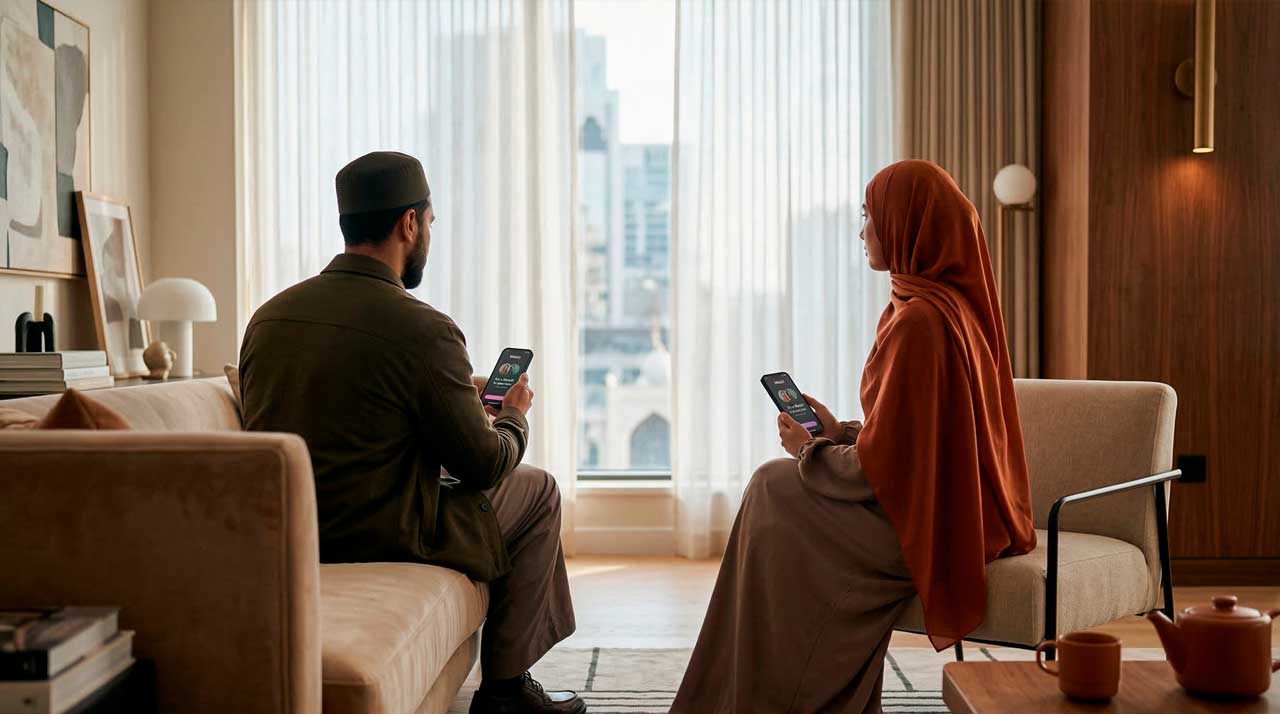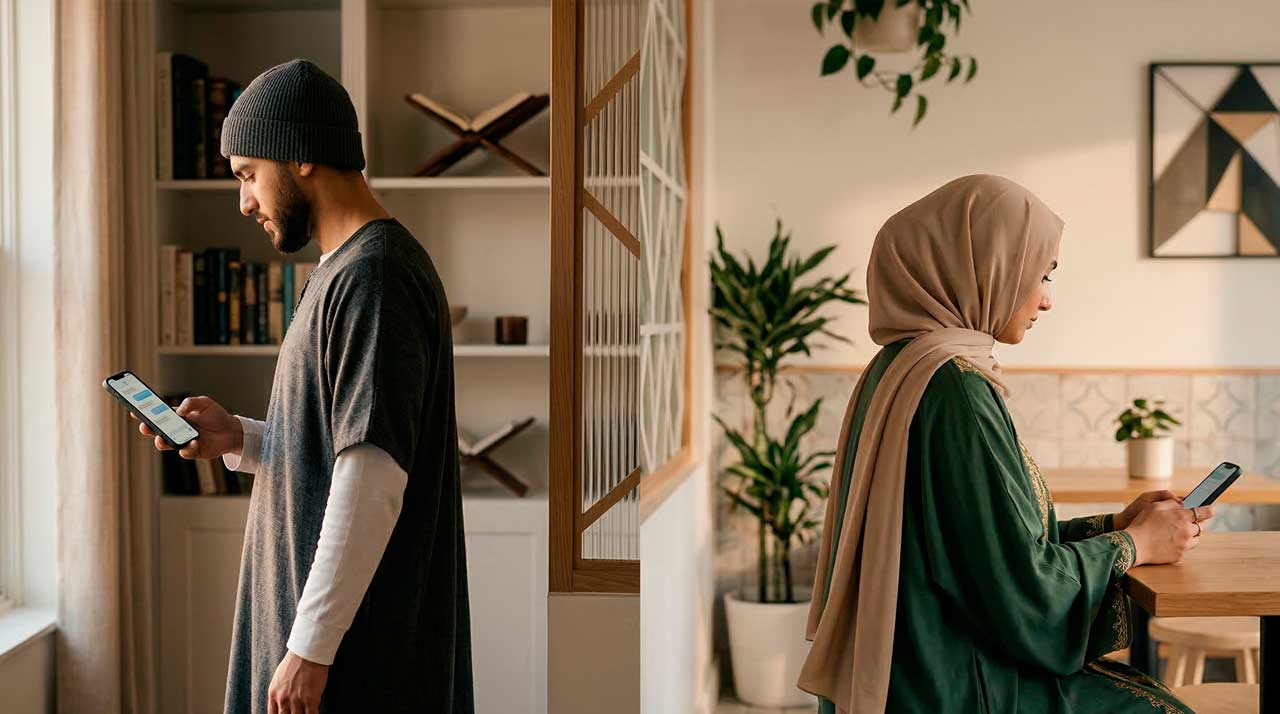
What Is Halal Dating? Defining the Concept {#what-is-halal-dating}
The term “halal dating” is one of the most searched and simultaneously most misunderstood phrases in the Muslim community today. To understand it properly, one must first separate it from the Western concept of dating entirely. In the Islamic tradition, there is no direct equivalent to Western-style dating — a process often characterized by casual, romantic exploration without a defined commitment or end goal. What Islam offers instead is a structured, supervised, and intentional process of getting to know a potential spouse, always with the explicit goal of marriage (Nikah).
Halal dating, therefore, is not dating in the conventional sense. It is better understood as Islamic courtship — a formal, family-involved, and spiritually grounded process of assessing compatibility for marriage. The word halal (حلال) means “permissible” in Arabic, and its application to courtship signals that the interaction is conducted within the boundaries set by Allah and His Messenger ﷺ.
The confusion arises because the phrase “halal dating” has been adopted by younger Muslims, particularly those living in Western countries, to describe a middle path between complete arranged marriage and Western-style dating. This middle path acknowledges the reality that many modern Muslims want to know their potential spouse before committing to marriage, while still honoring Islamic principles. As long as this process adheres to the guidelines outlined in Islamic jurisprudence (Fiqh), it is considered permissible.
“And of His signs is that He created for you from yourselves mates that you may find tranquility in them; and He placed between you affection and mercy. Indeed in that are signs for a people who give thought.” — Quran 30:21 (Ar-Rum)
This verse captures the Islamic vision of marriage: not a transaction, but a divinely ordained partnership built on tranquility (sakinah), affection (mawaddah), and mercy (rahmah). The process of finding that partner must reflect the same values.
The Theological Foundation: What the Quran and Hadith Say {#theological-foundation}
Before examining the practical rules of halal dating etiquette, it is essential to understand the theological reasoning behind them. Islamic boundaries in courtship are not arbitrary cultural restrictions — they are rooted in specific Quranic verses and Prophetic traditions (Hadith) that address human psychology, social structure, and spiritual protection.
The Prohibition of Approaching Zina
The most foundational verse governing pre-marital relationships is found in Surah Al-Isra:
“And do not approach unlawful sexual intercourse. Indeed, it is ever an immorality and is evil as a way.” — Quran 17:32
Islamic scholars note that Allah does not merely say “do not commit Zina (fornication)” but rather “do not approach it.” This linguistic choice is deliberate and profound. It means that all acts, situations, and environments that could lead to Zina are themselves forbidden. This is the theological basis for rules against seclusion, physical contact, and inappropriate communication — they are all considered “approaches” to Zina, even if Zina itself never occurs.
The Hadith on Seclusion (Khalwah)
The Prophet Muhammad ﷺ addressed the danger of seclusion directly:
“No man should be alone with a woman, and no woman should travel except with a Mahram.” — Sahih al-Bukhari 5233
“No man is alone with a woman but the third one is Satan.” — At-Tirmidhi 2165
These Hadith establish the prohibition of Khalwah (خلوة) — being alone in a private space with a non-Mahram member of the opposite sex. The wisdom here is psychological: the Prophet ﷺ acknowledged that human beings are susceptible to temptation, and that removing the opportunity for temptation is a mercy, not a punishment.
The Encouragement to Marry
Islam does not merely prohibit; it actively encourages marriage as the solution to the natural human desire for companionship:
“O young people! Whoever among you can marry, should marry, because it helps him lower his gaze and guard his modesty.” — Sahih al-Bukhari 5066
This Hadith is crucial because it frames the entire discussion of halal dating etiquette within a positive framework. The goal is not to suppress human emotion but to channel it toward a lawful, fulfilling, and spiritually rewarding union.
The 10 Core Principles of Halal Dating Etiquette {#core-principles}
The following principles represent the consensus of Islamic scholarship on permissible pre-marital interaction. They are not a checklist of restrictions but a framework for building a relationship with integrity, dignity, and divine blessing.
1. Sincerity of Intention (Niyyah)
Every interaction in the halal dating process must begin with a sincere and clear intention: the goal is marriage, not casual companionship, emotional entertainment, or physical gratification. This principle is non-negotiable. If a person enters the courtship process without a genuine intention to marry, the entire interaction becomes impermissible regardless of how “proper” it appears externally.
Before initiating contact with a potential spouse, a Muslim is encouraged to perform Istikhārah — the prayer of seeking guidance from Allah — to ensure that their intentions are pure and that they are seeking Allah’s will, not merely their own desires.
2. No Seclusion (Khalwah)
As established by Prophetic tradition, a man and woman who are not Mahram to each other must never be alone in a private space. This applies to physical meetings, but Islamic scholars have extended this principle to modern contexts: prolonged private messaging, late-night phone calls, and one-on-one video calls without a third party present all carry the spirit of Khalwah and should be avoided.
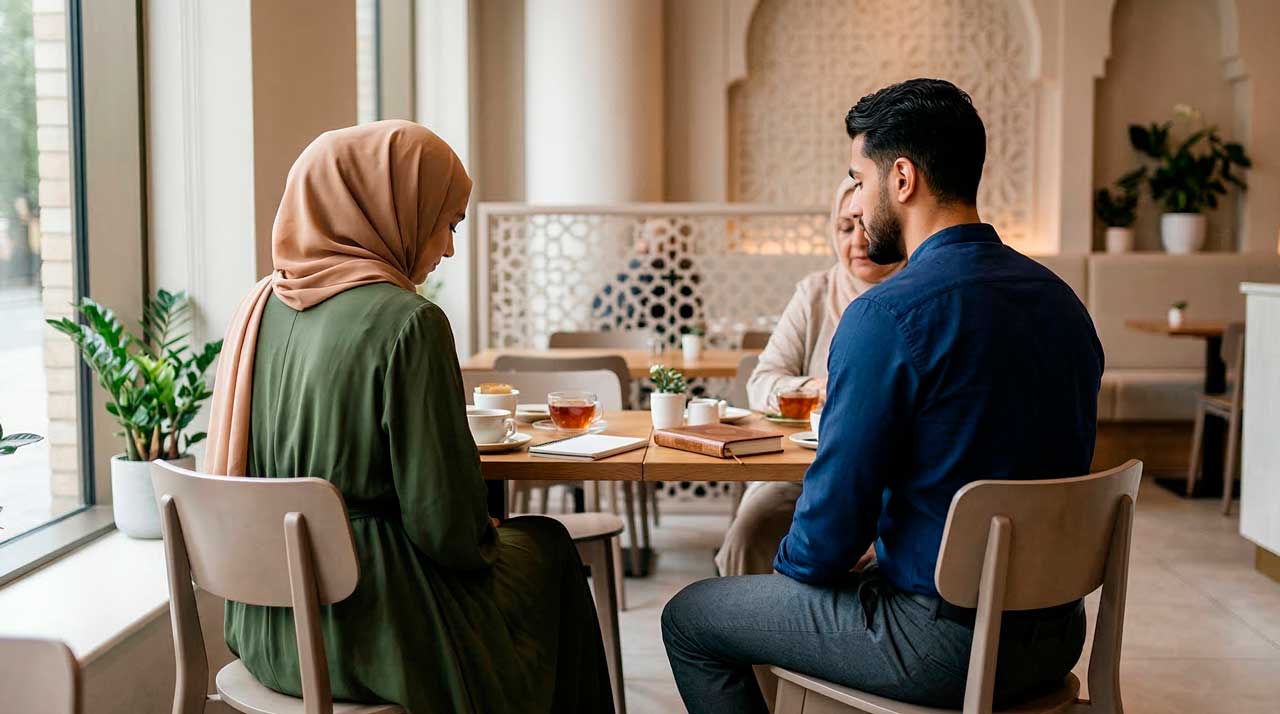
The practical implication is that all meetings must occur in public spaces or in the presence of a chaperone. A café, a park, a family home with family members present — these are all acceptable settings. A private apartment, a parked car, or any space where the two individuals are effectively alone is not.
3. No Physical Contact Before Nikah
Physical contact between non-Mahram individuals is prohibited in Islam. This includes holding hands, hugging, kissing, and any other form of touch. The Prophet ﷺ said:
“It is better for a man to be struck on the head with an iron nail than to touch a woman who is not lawful to him.” — At-Tabarani
This ruling applies to both men and women equally. The wisdom behind it is not merely moral but psychological: physical touch creates emotional bonds and neurochemical responses (such as the release of oxytocin) that can cloud judgment and accelerate emotional attachment beyond what is appropriate before a commitment has been made.
4. Modest and Purposeful Communication
Conversations during the halal courtship process must be focused, respectful, and purposeful. The purpose of communication is to assess compatibility — values, life goals, religious commitment, family expectations, and character. It is not an opportunity for flirtation, playful banter, or the kind of intimate emotional sharing that belongs within marriage.
Allah cautions specifically about the tone of speech:
“Do not be soft in speech, lest he in whose heart is disease be moved with desire.” — Quran 33:32 (Al-Ahzab)
While this verse was addressed to the wives of the Prophet ﷺ, scholars apply its principle broadly: speech should be dignified and professional in tone, not coy, suggestive, or designed to create emotional dependency.
5. No Lewd Talk or Inappropriate Messages
Explicit conversations about sex, intimate fantasies, or any form of sexual content are strictly forbidden during the halal courtship process. This applies to spoken conversation, text messages, voice notes, and any other medium of communication. The prohibition extends to sending or receiving suggestive images, videos, or memes.
This principle is directly connected to the broader Islamic concept of haya (حياء) — modesty and shame — which the Prophet ﷺ described as a branch of faith:
“Modesty is part of faith.” — Sahih Muslim 37
6. Family Involvement from the Beginning
One of the most distinctive features of halal dating etiquette is the active involvement of families from the very start of the process. This is not merely a cultural tradition but an Islamic requirement. The Wali (guardian) of the woman must be informed and involved, and both families should be aware that a potential match is being explored.
Family involvement serves multiple purposes: it provides accountability, reduces the risk of deception, ensures that the process is transparent and serious, and brings the wisdom of experienced elders into what can be an emotionally charged process.
7. Parental Approval and the Role of the Wali
In Islamic jurisprudence, a woman’s Wali (guardian, typically her father or closest male relative) plays a formal role in the marriage process. While the woman’s consent is absolutely required for a valid Nikah, the Wali’s involvement is also required. This dual requirement — consent of both the woman and her Wali — reflects Islam’s balanced approach to individual agency and family structure.
During the courtship process, seeking parental approval is not merely a formality. It is an act of respect, a safeguard against hasty decisions, and a means of ensuring that the relationship is built on a foundation of transparency rather than secrecy.
8. Respecting Boundaries at All Times
Both parties in a halal courtship have the right and responsibility to set and enforce personal boundaries. A woman has the right to refuse any question she finds inappropriate, to end a meeting if she feels uncomfortable, and to withdraw from the courtship process at any time without social pressure or guilt. A man has the same rights. Respecting these boundaries is not optional — it is an expression of the Islamic value of karamah (human dignity).
9. Keeping the Courtship Period Short
Extended “talking stages” that last months or years without progressing toward marriage are discouraged in Islam. The longer a pre-marital relationship continues without commitment, the greater the risk of emotional entanglement, physical temptation, and the development of an attachment that is not sanctioned by Allah. Islamic scholars generally advise that if two people are compatible, they should move toward Nikah without unnecessary delay. If they are not compatible, they should part ways respectfully and promptly.
10. Maintaining Strong Faith Throughout
The halal dating process should not distract a Muslim from their religious obligations. Regular prayer, Quran recitation, fasting, and other acts of worship must continue without interruption. In fact, the courtship period is an ideal time to observe how a potential spouse practices their faith — do they pray on time? Do they speak about Allah with reverence? Do they maintain Islamic etiquette even when it is inconvenient? These observations are among the most valuable assessments a Muslim can make during courtship.
The Role of the Wali and Mahram {#wali-and-mahram}
Two concepts that are central to halal dating etiquette — and frequently misunderstood — are the Wali and the Mahram. While they are related, they serve distinct functions.
| Term | Definition | Role in Courtship |
|---|---|---|
| Wali | The woman’s guardian (typically father, then paternal grandfather, then brother, then uncle) | Must be informed and involved; represents the woman in formal marriage proceedings |
| Mahram | A man who is permanently unmarriageable to a woman (father, brother, son, uncle by blood) | May serve as chaperone; his presence prevents Khalwah |
| Wali al-Amr | The broader guardian in the absence of a biological Wali | May be an Islamic authority or community leader |
A Mahram is always a Wali, but a Wali is not always a Mahram. For example, a woman’s paternal cousin may be her Wali in certain circumstances but is not her Mahram (since marriage between cousins is permitted in Islam).
The practical implication for halal dating is that a Mahram should be present during in-person meetings to prevent Khalwah. This does not mean the Mahram must sit between the two individuals and monitor every word — it means that a trusted family member is present in the same environment, ensuring that the interaction remains proper.
For women who do not have a biological Wali (due to death, estrangement, or conversion to Islam), many Islamic scholars advise seeking the assistance of a local imam or Islamic community leader who can fulfill the Wali’s role in the marriage process.
Chaperone Dating: Traditional Practice in a Modern World {#chaperone-dating}
The concept of chaperone dating is perhaps the most discussed and debated aspect of halal dating etiquette, particularly among younger Muslims in Western countries. A chaperone (mahram or trusted family member) is present during meetings between potential spouses to ensure that the interaction remains within Islamic boundaries.
What Chaperone Dating Actually Looks Like
Contrary to the caricature of a stern father sitting between two nervous young people, modern chaperone dating takes many forms:
In-person meetings: A family member or trusted friend accompanies one or both parties to a public meeting place — a café, a restaurant, a park. The chaperone may sit at a nearby table, giving the couple space to converse while remaining visible and accessible. The chaperone’s role is not to eavesdrop but to ensure that the meeting remains public and proper.
Group dates: Rather than a one-on-one meeting, the initial stages of courtship may involve group outings — family gatherings, community events, or social activities with friends present. This allows the two individuals to observe each other in natural social settings.
Video calls with a witness: For long-distance courtship or initial conversations, a family member may be present during video calls, or the call may be conducted in a shared family space rather than in private.
Digital chaperones: In the era of halal dating apps, the concept of the chaperone has been adapted for the digital world. Apps such as Muzz offer a “Chaperone Mode” that allows a Wali to receive weekly transcripts of conversations between users, ensuring that communication remains appropriate. The VEIL app allows a woman’s Wali to monitor chats in real time. [1] [2]
The Wisdom Behind Chaperone Dating
The chaperone system is often criticized as infantilizing or overly restrictive, particularly by those who view it through a Western cultural lens. However, its wisdom becomes apparent when considered from a psychological and sociological perspective. Research consistently shows that the presence of a third party changes behavior — people are more thoughtful, more restrained, and more honest when they know they are being observed. The chaperone system essentially builds accountability into the courtship process, protecting both parties from decisions they might later regret.
Moreover, the chaperone system signals seriousness. A man who is willing to meet a woman in the presence of her family is demonstrating that his intentions are genuine and that he respects her family’s role in her life. This is, in itself, an important character assessment.
Halal vs. Haram: A Clear Comparison {#halal-vs-haram}
One of the most practical tools for navigating halal dating etiquette is a clear understanding of what is permitted and what is not. The following table provides a comprehensive comparison:
| Aspect | Halal (Permissible) | Haram (Forbidden) |
|---|---|---|
| Setting | Public spaces, family home with family present | Private spaces, being alone together |
| Physical contact | None before Nikah | Any physical touch (handshake, hug, kiss) |
| Communication | Purposeful, formal, marriage-focused | Flirtatious, intimate, sexual, or excessive |
| Family involvement | Active involvement from the start | Secret relationship hidden from family |
| Intention | Marriage as the explicit goal | Casual companionship, emotional entertainment |
| Duration | Short and purposeful | Extended “talking stage” without commitment |
| Chaperone | Present during in-person meetings | Absent; couple meets alone |
| Content of conversation | Values, goals, compatibility, faith | Sex talk, intimate fantasies, lewd jokes |
| Online communication | Formal, transparent, purposeful | Late-night private messaging, explicit content |
| Emotional depth | Appropriate to the stage of courtship | Deep emotional intimacy before Nikah |
Purity, Modesty, and Emotional Boundaries {#purity-and-modesty}
Halal dating etiquette is not only about physical boundaries — it is equally concerned with emotional and spiritual purity. This is a dimension that is often overlooked in discussions of Islamic courtship but is arguably the most challenging to maintain in the modern world.
The Concept of Haya (Modesty)
Haya (حياء) is one of the most important values in Islamic ethics. It is often translated as “modesty” or “shyness,” but it encompasses a much richer concept: a sense of shame, dignity, and self-respect that governs behavior in all contexts, not just sexual ones. The Prophet ﷺ said:
“Every religion has a characteristic, and the characteristic of Islam is modesty.” — Sunan Ibn Majah 4182
In the context of halal dating, haya means maintaining a dignified demeanor, avoiding behavior that would be considered inappropriate in the presence of one’s family, and treating the potential spouse with the respect one would show a stranger of good standing — not with the familiarity that belongs within marriage.
Emotional Purity: The Hidden Challenge
Perhaps the greatest challenge of modern halal dating is maintaining emotional boundaries. It is entirely possible to follow all the physical rules of halal dating — no touching, no seclusion, chaperone present — while simultaneously developing an emotionally intimate relationship that is psychologically equivalent to a romantic relationship. This is sometimes called “emotional Zina” by Islamic counselors, and it is a real and serious concern.
Signs that emotional boundaries are being crossed include: thinking about the person constantly, sharing deeply personal secrets, relying on them for emotional support before marriage, feeling devastated at the thought of the courtship ending, and prioritizing communication with them over religious obligations or family relationships.
The antidote to emotional over-attachment is intentionality and structure. Conversations should be purposeful and time-limited. The courtship should progress at a pace that allows for genuine assessment without fostering unhealthy attachment. And throughout the process, both parties should maintain their primary emotional relationship with Allah, their families, and their existing support networks.
Lowering the Gaze
The Quran specifically instructs both men and women to lower their gaze:
“Tell the believing men to lower their gaze and guard their private parts; that is purer for them. Indeed, Allah is Acquainted with what they do.” — Quran 24:30 (An-Nur)
“And tell the believing women to lower their gaze and guard their private parts…” — Quran 24:31 (An-Nur)
In the context of halal dating, lowering the gaze does not mean refusing to look at a potential spouse — the Prophet ﷺ actually encouraged looking at a potential spouse before marriage. Rather, it means avoiding prolonged, lingering, or lustful gazing that is designed to arouse desire rather than assess character.
Halal Dating in the Digital Age: Apps, Social Media, and Online Communication {#digital-age}
The rise of digital communication has fundamentally changed the landscape of Muslim courtship, creating both new opportunities and new challenges. Today, millions of Muslims around the world use dedicated halal dating apps to find potential spouses, and the question of how to apply traditional Islamic principles to digital communication is one of the most pressing issues in contemporary Islamic jurisprudence.
The Major Halal Dating Apps
Several apps have been specifically designed to facilitate Islamic courtship while maintaining halal boundaries:
Salams (formerly Minder)6+ million usersFamily involvement features, intention-setting
| App | Key Features | Halal-Specific Features |
|---|---|---|
| Muzz (formerly Muzmatch) | 10+ million users globally | Chaperone Mode (weekly chat transcripts to Wali) |
| NikahPlus | 90+ thousand users globally | AI assistant for marriage readiness, full wali system, education |
| VEIL | Wali-centered design | Real-time Wali monitoring of chats |
| Hawaya | AI-powered matching | Modesty filters, family profiles |
| Muslima | Part of Cupid Media network | Islamic profile questions, modesty settings |
Islamic Principles for Online Communication
The same principles that govern in-person halal dating apply to digital communication, with some additional considerations:
Transparency: Online communication should never be secret. Both parties should be comfortable with their family members seeing their messages. If you would not want your father or mother to read a message, it should not be sent.
Time and frequency: Communicating at all hours of the night, or spending hours daily in private conversation, creates the conditions for emotional Khalwah even without physical proximity. Islamic scholars advise keeping digital communication purposeful and time-limited.
The digital chaperone: Just as a physical chaperone is recommended for in-person meetings, a digital chaperone — a family member who is aware of and has access to the communication — is recommended for online courtship. This can be achieved through the Chaperone Mode features offered by apps like Muzz, or simply by conducting conversations in shared family spaces rather than in private.
Profile modesty: On halal dating apps, profile photos should reflect Islamic standards of modesty. Women who observe hijab should maintain their hijab in profile photos. Profile descriptions should focus on character, values, and goals rather than physical attributes.
Social Media and Halal Dating
Social media platforms present particular challenges for halal dating etiquette. The casual, public nature of social media can blur the lines between appropriate and inappropriate interaction. Following, liking, and commenting on a potential spouse’s social media posts can quickly become a form of digital flirtation that violates the spirit of halal courtship.
The recommended approach is to keep social media interaction minimal and formal until after the Nikah. If communication is necessary, it should be moved to a more controlled environment — such as a dedicated messaging app where a chaperone can be involved — rather than conducted through public social media platforms.
Halal Dating for Muslim Women: Rights, Agency, and Etiquette {#muslim-women}
A common misconception about halal dating is that it places all the agency with men and families, leaving women as passive participants in their own marriage process. This is a misreading of Islamic jurisprudence. Islam grants Muslim women significant rights and agency in the courtship process, and understanding these rights is essential to a complete picture of halal dating etiquette.
The Right to Consent
The Prophet ﷺ explicitly stated that a woman’s consent is required for a valid marriage:
“A previously married woman should not be given in marriage until she has been consulted, and a virgin should not be given in marriage until her permission is sought.” — Sahih al-Bukhari 5136
A marriage conducted without the woman’s genuine, freely given consent is invalid in Islamic law. This means that a woman has the absolute right to refuse a proposal, regardless of her family’s wishes. While family input is valued and respected, it cannot override the woman’s own decision.
The Right to Ask Questions
A Muslim woman has the full right to ask any appropriate question she wishes in order to assess the suitability of a potential spouse. This includes questions about his financial situation, his religious practice, his relationship with his family, his expectations of marriage, his career goals, and any other matter that is relevant to compatibility. She is not required to accept a proposal simply because her family approves of the man.
The Right to Set Her Own Mahr
The mahr (marriage gift) is a mandatory gift from the husband to the wife, and it is the woman’s exclusive right — not her family’s. She has the right to set her own mahr and to negotiate its terms. This is an important expression of her agency and dignity in the marriage process.
The Right to End the Courtship
A Muslim woman has the right to withdraw from the courtship process at any time, for any reason, without being pressured or shamed. If she determines that a potential spouse is not suitable — for reasons of character, compatibility, or simply a lack of connection — she is entitled to end the process respectfully and without guilt.
Etiquette for Muslim Women in Halal Dating
While Muslim women have significant rights in the courtship process, they also have specific responsibilities under Islamic etiquette:
Maintaining modesty in dress and behavior during meetings is essential. Avoiding excessive communication with a potential spouse before the Wali has been formally involved protects both parties from premature emotional attachment. Being honest about her own values, expectations, and non-negotiables from the beginning saves time and prevents misunderstandings. And involving her Wali from the start — not as a gatekeeper, but as a trusted advisor and protector — ensures that the process is conducted with integrity.
Navigating Halal Dating in Western Societies {#western-societies}
For Muslims living in Western countries — the United States, the United Kingdom, Canada, Australia, and across Europe — the challenge of maintaining halal dating etiquette is compounded by the surrounding culture’s very different norms around relationships, dating, and marriage. Understanding these challenges and developing practical strategies to address them is essential for Muslim singles in the West.
The Cultural Pressure Challenge
Western dating culture is pervasive and normalized. From television and film to social media and peer relationships, the message that casual dating, physical intimacy before marriage, and romantic relationships without commitment are normal and desirable is constant and unavoidable. Muslim singles in the West must navigate this cultural pressure while maintaining their Islamic values — a task that requires both clarity of conviction and practical strategies.
One of the most effective strategies is community involvement. Muslims who are actively engaged in their local mosque community, Islamic student associations, or Muslim social groups have access to a network of like-minded individuals who share their values. This community provides both social support and practical opportunities for halal courtship.
The Family Distance Challenge
Many Muslims in the West live far from their extended families, making the traditional model of family-involved courtship logistically challenging. When a potential spouse’s family is in another country, or when a Muslim has converted and their family is non-Muslim, the standard model of Wali involvement requires adaptation.
In these situations, Islamic scholars advise seeking the assistance of a local imam or respected community leader who can fulfill the Wali’s role. Many mosques in Western countries have established formal processes for assisting Muslims who lack a local Wali, recognizing that this is a genuine and common need.
The Workplace and Social Circle Challenge
In Western societies, Muslims frequently interact with non-Mahram members of the opposite sex in professional and social settings. This creates situations where the lines between appropriate professional interaction and inappropriate personal interaction can become blurred. The key principle is intentionality: professional interaction for a legitimate purpose is permissible; personal interaction that goes beyond professional necessity and begins to develop into a private relationship is not.
If a Muslim develops an interest in a colleague or acquaintance, the halal approach is to involve family and proceed through formal channels — not to develop a private relationship under the cover of professional interaction.
Common Mistakes and How to Avoid Them {#common-mistakes}
Even Muslims who are sincerely committed to halal dating etiquette can fall into patterns that gradually erode their boundaries. The following are the most common mistakes in halal courtship and practical strategies for avoiding them.
- Mistake 1: The Extended Talking Stage. Many Muslim singles spend months or years in a “talking stage” — communicating regularly with a potential spouse without any formal commitment or family involvement. This extended limbo creates emotional attachment without accountability and is one of the most common paths to haram behavior. The solution is to involve families early and set a timeline. If the courtship is not progressing toward Nikah within a reasonable timeframe, it should either be formalized or ended.
- Mistake 2: Treating Digital Communication as a Private Space. The anonymity and privacy of digital communication can make it feel like a separate, consequence-free zone. Muslims sometimes say and share things in private messages that they would never say in person or in front of their families. The solution is to apply the same standards to digital communication as to in-person interaction — if you would not say it in front of your parents, do not type it.
- Mistake 3: Neglecting the Wali. Some Muslim women, particularly those who are independent and educated, resist involving their Wali because it feels infantilizing or because they fear their family’s disapproval. However, bypassing the Wali creates a relationship built on secrecy, which is contrary to the spirit of halal courtship. The solution is to reframe the Wali’s role as an advisor and protector, not a controller — and to have an honest conversation with the Wali about expectations and boundaries.
- Mistake 4: Confusing Emotional Intimacy with Compatibility. Feeling deeply connected to someone emotionally does not necessarily mean they are a good match for marriage. Emotional intimacy can develop quickly and powerfully, especially in the absence of physical boundaries, and can cloud judgment about genuine compatibility. The solution is to maintain structured, purposeful conversations that focus on practical compatibility — values, goals, family expectations, religious practice — rather than emotional bonding.
- Mistake 5: Ignoring Red Flags Out of Emotional Investment. Once a Muslim has invested time and emotional energy in a courtship, they may be reluctant to acknowledge red flags — signs of poor character, dishonesty, disrespect for Islamic values, or incompatibility. The solution is to involve trusted family members and advisors who can provide an objective perspective, and to remember that ending a courtship is far less painful than ending a marriage.
Practical Scenarios: What Halal Dating Actually Looks Like {#practical-scenarios}
Abstract principles are most useful when grounded in concrete examples. The following scenarios illustrate how halal dating etiquette applies in real-world situations.
Scenario 1: Meeting Through a Halal Dating App
Fatima, 26, and Omar, 28, both living in London, match on a halal dating app. Their initial exchange is brief and formal — they share their basic backgrounds, their intentions (both are seeking marriage), and their religious practice. After a few exchanges, Omar asks for Fatima’s Wali’s contact information. He contacts her father, introduces himself, and requests permission to meet Fatima in a supervised setting. The families exchange information, and a meeting is arranged at a café where Fatima’s brother is present at a nearby table. After three such meetings, both families meet together. After six weeks, Omar proposes formally. The entire process, from first contact to proposal, takes two months.
Scenario 2: Meeting Through the Mosque Community
Aisha, 24, meets Ibrahim, 30, at a community event at her local mosque. They speak briefly in a group setting. Ibrahim approaches Aisha’s father after the event and expresses his interest in getting to know Aisha with the intention of marriage. Her father facilitates a series of family visits where Aisha and Ibrahim can speak in the presence of both families. After four visits over six weeks, they perform Istikhārah and decide to proceed with the Nikah.
Scenario 3: Long-Distance Courtship
Yusuf, 29, in New York, is introduced to Maryam, 27, in Toronto, through mutual family friends. They begin communicating via video call, with Maryam’s mother present during each call. They use the Chaperone Mode on a halal dating app for text communication, with Maryam’s father receiving weekly transcripts. After two months of video calls, Yusuf travels to Toronto to meet Maryam and her family in person. After a further month of consideration and Istikhārah, they agree to proceed with the Nikah.
Scenario 4: Navigating a Workplace Interest
Khalid, 31, develops an interest in a Muslim colleague, Nadia, 28. Rather than pursuing a private relationship at work, he approaches a mutual friend who knows Nadia’s family and asks to be formally introduced. The introduction is made through family channels, and the courtship proceeds through the standard halal process — family involvement, supervised meetings, and a clear timeline toward marriage.
Frequently Asked Questions {#faqs}
No. Physical contact between non-Mahram individuals is prohibited in Islam, and this includes handshakes. The Prophet ﷺ never shook hands with a non-Mahram woman. While this may seem overly strict in a Western cultural context, maintaining this boundary is an important expression of respect for Islamic principles.
A brief, formal initial exchange to establish basic compatibility and mutual interest is generally considered permissible. However, extended private communication before the Wali is involved is discouraged, as it creates the conditions for emotional attachment without accountability. The Wali should be involved as early as possible in the process.
Islam prohibits discrimination based on ethnicity or nationality in marriage. The Prophet ﷺ said:
"An Arab has no superiority over a non-Arab, nor does a non-Arab have superiority over an Arab."
If a parent's objection is based on such discrimination, the woman has the right to seek the assistance of an Islamic authority to fulfill the Wali's role. However, this should be a last resort after sincere efforts at family reconciliation.
Islamic jurisprudence permits Muslim men to marry women from the People of the Book (Jews and Christians), though this is generally discouraged due to the challenges it poses for raising Muslim children. Muslim women, however, are not permitted to marry non-Muslim men. In either case, "dating" a non-Muslim in the Western sense — without a clear path to marriage — is not permissible.
There is no fixed timeline, but Islamic scholars generally advise that the courtship should be purposeful and not unnecessarily prolonged. A period of one to three months is often sufficient to assess basic compatibility. If both parties and their families are satisfied, the Nikah should proceed without delay. Extended courtships of a year or more are generally discouraged.
Ending a courtship is entirely permissible at any stage before the Nikah. It is far better to end a courtship that is not working than to proceed to a marriage that will be unhappy. The ending should be done respectfully, with honesty and kindness, and without causing unnecessary harm to the other party's reputation.
Yes. A woman may express interest in a man through her Wali, who can then approach the man's family. Alternatively, a woman may approach a man directly in a formal, modest manner to express her interest in being introduced through proper channels. The Prophet ﷺ received a proposal from Khadijah (RA), who initiated the process through a trusted intermediary.
Istikhārah is a two-unit prayer performed when a Muslim faces an important decision. It is a supplication asking Allah to guide the person toward what is good for them in this life and the next. In the context of halal dating, Istikhārah should be performed before initiating a courtship, before agreeing to a formal proposal, and at any other significant decision point in the process. It is not a magic sign — the answer comes through a feeling of ease or difficulty, through circumstances that open or close, and through the guidance of trusted advisors.
Conclusion
Halal dating etiquette is not a set of arbitrary restrictions designed to make finding a spouse difficult. It is a divinely guided framework designed to protect human dignity, preserve emotional and spiritual purity, and lay the foundation for a marriage that is built on integrity, mutual respect, and the blessing of Allah. In a world where casual relationships, emotional exploitation, and the commodification of romance have become the norm, the Islamic approach to courtship offers something genuinely countercultural: a path to love that is clean, dignified, and spiritually meaningful.
The principles outlined in this guide — sincerity of intention, no seclusion, no physical contact, modest communication, family involvement, chaperone presence, and strong faith — are not obstacles to finding love. They are the conditions under which love, in its truest and most lasting form, can flourish.
For Muslim singles navigating the challenges of modern courtship — whether in the West or the East, on dating apps or through community networks — the message of halal dating etiquette is ultimately one of hope: that it is possible to find a righteous spouse, to build a beautiful marriage, and to do it all in a way that pleases Allah.
“And whoever fears Allah — He will make for him a way out and will provide for him from where he does not expect.” — Quran 65:2-3 (At-Talaq)
References
[2] VEIL App. “The Leading Free Muslim Marriage App.” https://www.veil.mobi/
[3] Salams. “8 Muslim Dating Rules and Traditions You Need to Know.” https://www.salams.app/
[4] IMAN School. “Dating in Islam – What’s Allowed and Forbidden.” https://www.iman-school.com/
[5] Muzz Blog. “Muslim Dating Rules: What You Need to Know Before You Start Dating.” https://muzz.com/
[6] Rafeeqee Foundation. “Islamic Courtship: Boundaries, Etiquette, and a Better Way Forward.” https://rafeeqee.com/
[7] Shifa Therapy. “Dating Culture vs Islamic Boundaries: 6 Rules for Single Muslims.” https://shifatherapy.com/
[8] Mindful Muslimah. “Halal Dating Guide | Islamic Spouse Search Strategies.” https://mindful-muslimah.com/
[9] Sunnah.com. “Sahih al-Bukhari 5066.” https://sunnah.com/
[10] Quran.com. “Surah Ar-Rum 30:21.” https://quran.com/ar-rum/21
[11] Vogue Arabia. “Why Some Muslim Women Are Bringing Their Guardians to Digital Dating.” https://www.voguearabia.com/
[12] About Islam. “Are Muslims Allowed to Date?” https://aboutislam.net/